Millions of people today feel deeply interested in spiritual meaning yet allergic to anything resembling organized religion. They’re not rejecting spirituality itself. They’re rejecting the containers that once held it — the dogma, the hierarchy, the exclusivity, the sense that someone else gets to define what’s true.
And in that tension, something new is taking shape.
People are stepping away from traditional religious institutions while still asking the same timeless questions:
Who am I?
What is the nature of reality?
Where do I fit in the larger universe?
These questions don’t disappear when religion does. In many ways, they become sharper — and they invite people to explore ideas drawn from multiple traditions, woven together into new ways of seeing.
Non‑Dualism: An Older Idea Reappearing in a New Context
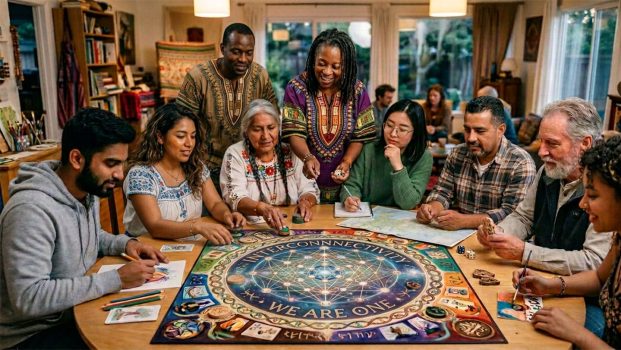
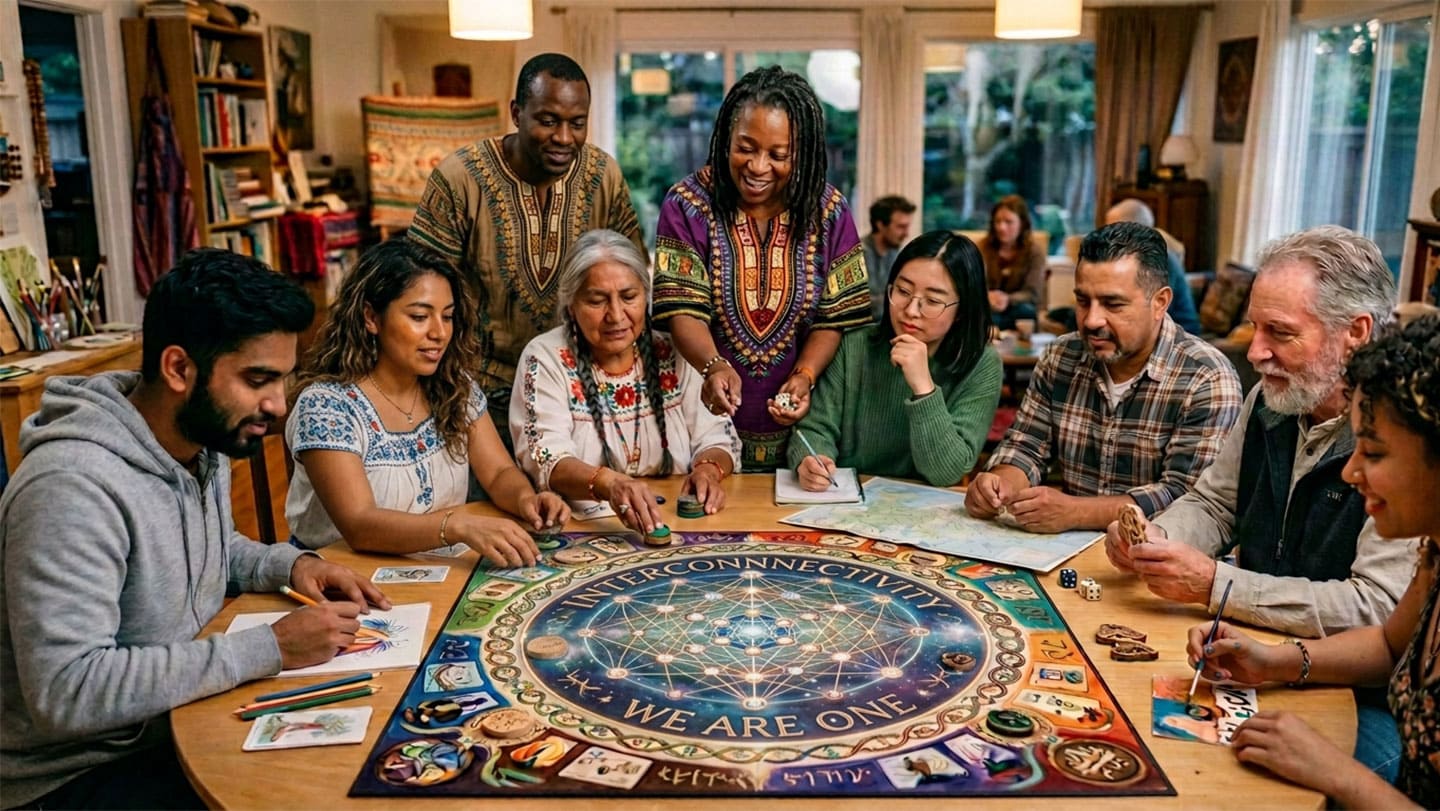
As people search for meaning outside traditional religion, many find themselves drawn to a simple but powerful idea: everything is interconnected — that we’re all expressions of one larger consciousness, not separate beings moving through a fragmented universe. Instead of imagining reality as divided into parts — God here, people there, nature somewhere else — this perspective suggests that all of it arises from a single underlying source.
The concept is not new. Versions of it appear across cultures and eras, but one of the clearest and most influential expressions is found in Advaita Vedanta, an ancient Hindu philosophical tradition that emerged between the 7th and 9th centuries CE. Its central insight is straightforward yet profound: There is one reality, and we are expressions of it.
What’s new is that, without necessarily knowing it, a growing number of people today are rediscovering this ancient wisdom through modern lenses — psychology, neuroscience, cosmology, quantum physics, meditation, and secular spirituality. Instead of encountering non‑dualism through religious institutions, they’re encountering it through contemporary explorations of consciousness and reality. In the process, many are moving away from dogma‑based frameworks toward ways of understanding the world that feel more aligned with today’s scientific, cultural, and existential landscape.
This rediscovery of non‑dual ideas creates a natural bridge to another moment in history when similar ideas were being reinterpreted for a new cultural context — the early 20th century, when Ernest Holmes began shaping what would become known as New Thought.
New Thought: A Modern American Interpretation
By the early 20th century, the Western world was experiencing a remarkable influx of new ideas. Eastern philosophies were being translated and discussed publicly for the first time. Transcendentalism had opened the door to intuition and inner experience. Theosophy was introducing Western audiences to Hindu and Buddhist concepts. Early psychology was reframing consciousness in scientific terms. It was a melting pot of emerging worldviews, and people were experimenting with new ways of understanding reality.
It was in this environment that Ernest Holmes emerged — not as a minister in the traditional sense, and not as a theologian, but as a writer, lecturer, and synthesizer of ideas. Holmes was particularly drawn to the ancient non‑dual wisdom of Advaita Vedanta, the Hindu philosophical tradition teaching that the ultimate reality (Brahman) is singular and that the individual self (Atman) is not separate from that reality. This insight — that everything is interconnected and arises from one underlying source — became the central thread Holmes carried forward.
Holmes also drew on three other threads emerging at the time, each contributing a distinct element to the worldview he eventually articulated:
- Theosophy — a late‑19th‑century movement blending Eastern metaphysics with Western esotericism.
- Ralph Waldo Emerson — a mid‑19th‑century transcendentalist emphasizing intuition and the divine within.
- Early psychology and American transcendentalism — explorations of consciousness that gave Holmes modern language for inner experience.
He stitched these ideas together, simplified them, eliminated the esoteric elements of Theosophy, Westernized Advaita so it could be understood by the Western mind, and packaged his synthesis partly in modern psychological language — all while keeping the essential insight that reality is non‑dual — in other words, that we are all part of one interconnected whole. This synthesis became part of what is now called New Thought, a movement whose central ideas can be understood as extensions or reinterpretations of the earlier traditions:
- The Divine as an Indwelling Presence — echoing Emerson’s view of the divine within, and Advaita’s teaching that the ultimate reality is not separate from the self.
- The Interconnectedness of Reality — directly reflecting Advaita Vedanta’s non‑dualism and Theosophy’s emphasis on universal unity.
- The Creative Nature of Thought — influenced by early psychology and transcendentalism, reframing consciousness as participatory rather than passive.
- Universal Spiritual Principles — a simplified reinterpretation of Theosophy’s metaphysical laws and Advaita’s consistent metaphysical structure.
- The Validity of Personal Experience — aligned with transcendentalism and modern psychology, emphasizing intuition and inner insight over external authority.
- Inclusivity of Multiple Traditions — reflecting Theosophy’s syncretic approach and Emerson’s openness to global wisdom traditions.
Holmes didn’t create a new religion. He created a new synthesis — a worldview that recombined elements of older ones into a modern, psychologically accessible form. And because it preserved the non‑dual core while removing the doctrinal and esoteric layers, it became one of the early expressions of the emerging worldview we see today.
Holmes’s View of God as Love — and How It Relates to Advaita Vedanta’s Brahman
Ernest Holmes taught that God is the creative force of the universe, and he spoke of God in terms of Love. He wasn’t referring to emotion or sentiment. He meant Love as the self‑giving, creative impulse of the One Reality — the energy through which life and experience come into being.
In Advaita Vedanta, the parallel to Holmes’s “God” is Brahman, the single, formless ground of being. Like Holmes, Advaita teaches that Brahman is the creative force of the universe, the source from which all manifestation arises. But Advaita describes Brahman’s nature not as “love” but as the related idea of bliss — the inherent fullness of pure consciousness, the overflowing nature of reality that gives rise to creation.
Both Holmes and Advaita are pointing to the same underlying reality: a single source that expresses itself through creation. Holmes interprets that expressive quality through a Western lens in which love names the creative impulse of the One. Advaita interprets it through an Eastern lens in which bliss refers to the inherent fullness of the One — a fullness that naturally includes its creative expression. In both cases, the Divine is understood as the creative force behind all becoming.
And Yes — You Can Find These Ideas in Today’s Spiritual Communities
Although many people explore these ideas privately, they also continue to exist in organized communities that draw from New Thought and non‑dual perspectives. One example is Centers for Spiritual Living (CSL) — a network of communities based on Ernest Holmes’s work.
If you’re curious about how these ideas show up in contemporary settings, you can learn more here: Centers for Spiritual Living
These communities are not presented as a direction or recommendation — simply as evidence that the search for meaning outside traditional religion has both individual and communal expressions.
And in a broader sense, they illustrate how worldviews evolve: old ideas recombine, new frameworks emerge, and people find fresh ways to understand reality in a changing world.