
A Story of Growth and Expansion
For nearly eighty years, Americans have lived inside a story shaped by the aftermath of World War II — a story of rising prosperity, expanding opportunity, and global leadership. It helped people make sense of life: who we are, what we can expect, and how the future should unfold.
That story began because the United States emerged from the war uniquely intact. Except for Pearl Harbor, no bombs fell on U.S. soil. American factories, infrastructure, and financial systems remained fully operational while much of the world lay in ruins. This gave the U.S. an extraordinary advantage: it could rebuild its own economy and help rebuild others, all while expanding its industrial and financial reach.
American factories ramped up production. The U.S. financial system lent globally. American institutions shaped international trade and monetary policy. The dollar became the global reserve currency.
On the home front, opportunity grew exponentially. The GI Bill expanded access to education and homeownership; suburbanization and mass consumer credit fueled unprecedented domestic demand; jobs multiplied; and prosperity seemed limitless.
As a result, Americans came to enjoy a lifestyle far beyond what most of the world could access — and gradually began taking it for granted. Over time, a worldview took shape which basically said: If you were an American, the future would always be bigger, better, richer, and more secure than the past. America would always be number one.
The American Empire
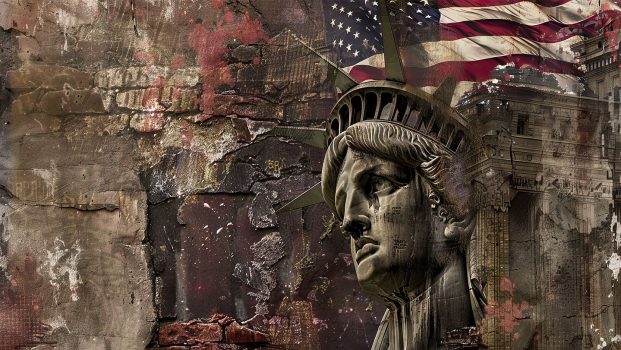
In effect, America became an empire — not through territorial conquest, but through global economic dominance, cultural influence, and institutional reach. By broad definition, an empire is a nation whose power extends far beyond its borders through military strength, economic leverage, and the ability to shape global norms. By that measure, the United States has been the central empire of the postwar world.
And as in all empires, its people saw themselves as the rightful recipients of the empire’s fruits.
But no empire lasts forever.
History shows that every empire — Roman, Ottoman, British, Greek, Egyptian, Mongol, Spanish — rose through some combination of economic strength, institutional coherence, cultural confidence, and technological advantage. And each eventually faced periods of strain as global conditions shifted.
The United States will be no exception. The question is: Has the long slide already begun?
Going Forward: The Economic Outlook
Economists aren’t predicting an imminent collapse. But the structural advantages the U.S. has enjoyed since World War II are clearly shifting.
Recent papers from major U.S. economic institutions provide evidence.
Federal Reserve: Rising Structural Fragility
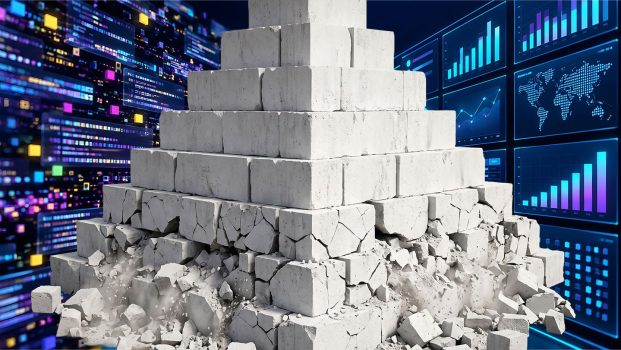
In 2026, a Federal Reserve research paper was produced that introduces the Financial Vulnerability Index (FVI), a measure designed to track the gradual buildup of structural weaknesses in the U.S. financial system. The authors find that when financial vulnerabilities are elevated, economic shocks tend to produce larger declines in consumption and investment, suggesting that structural weaknesses can amplify downturns.
While the paper does not argue that the United States is in decline, it does provide evidence that structural vulnerabilities can accumulate beneath the surface of otherwise stable economic conditions. The authors find that when those vulnerabilities are elevated, economic shocks have more severe effects, suggesting that long-term resilience depends not only on current growth but also on the underlying strength of financial institutions and markets.
Whether these vulnerabilities represent the early stages of a long-term decline or simply a period of adjustment remains an open question. What is clear is that economists and policymakers are paying increasing attention to the structural factors that may influence the nation’s resilience in the decades ahead.
Source: Beyond Financial Conditons: Measuring Structural Vulnerabilities in the U.S. Financial System.
IMF: Productivity Divergence
A 2025 IMF working paper, Economic Tectonics: A Closer Look at Structural Change and Productivity Trends in the U.S. Economy, points to a deeper structural transformation underway in the American economy. The study found that while highly productive tradable industries continue to generate strong productivity gains, nontradable sectors account for most employment and economic activity. The growing divergence between where productivity is generated and where most people work raises concerns about long-term growth, inequality, and economic resilience.
Though the authors do not argue that the United States is in decline, their findings suggest that important features of the postwar economic model are changing. Whether these trends represent the early stages of relative decline, a period of economic adaptation, or the emergence of a new economic order remains an open question. What is clear is that the structure of the American economy is evolving in ways that differ significantly from the decades following World War II.
Though neither paper predicts a decline, both suggest that important features of the postwar economic model are evolving. The broader question is whether these changes represent a temporary adjustment or part of a deeper transformation in America’s role within an increasingly multipolar world.
Global Power Is Expanding
The U.S. economy is inextricably intertwined with a global economy that is clearly undergoing a reshuffling. China’s GDP already exceeds that of the U.S. in purchasing‑power terms. India has become the world’s fastest‑growing major economy and is projected to become the third largest. And across Southeast Asia, parts of Africa, and Latin America, rapid modernization is underway — in some cases leapfrogging older systems entirely.
A major driver of these shifts is the transformation of global supply chains. For decades, multinational corporations relied on a centralized model: manufacture in one country (often China), ship everywhere else. That model is now being rethought. Companies are diversifying production across multiple nations, reducing dependence on any single region, and reshoring certain critical industries back to the United States.
The result is a world that is more interconnected — but also more complex. Economic power is no longer defined by a single dominant hub, but by a network of rising centers. The United States remains a major engine of global growth, but it is now one among several.
Beyond Economics
Economics sheds light on a sliver of the story, but empires rarely shift because of economics alone. Economic weakness is often the surface expression of deeper cracks in the system in areas as diverse as political gridlock, cultural fragmentation, demographic shifts, technological disruption, the collapse of religious beliefs, and the inability of governing systems to adapt.
And today, as with prior empire declines, even long‑standing meaning‑making institutions, including religious ones, struggle to provide the coherence they once offered — resulting in a growing number of people feeling unmoored, without a shared framework for interpreting rapid change.
Political turbulence, polarization, contested legitimacy, governing paralysis are all reflections of a system straining under the weight of a society transforming faster than its institutions can respond.
Taken together, these pressures offer even more reason to consider that the American Empire may be entering a period of decline.
The Acceleration of Change
These various institutional strains are unfolding alongside something unprecedented: the sheer speed of scientific and technological advancement.
Artificial intelligence is evolving exponentially. Automation is reshaping industries faster than policy can adapt. Biotechnology, quantum computing, and climate science are redefining the boundaries of what is possible — and what is uncertain.
And this acceleration is no longer driven by the United States alone. China, India, Japan, South Korea, and other rapidly modernizing nations are advancing breakthroughs of their own. Together, their momentum is fueling a global technological surge far larger than what the U.S. could produce on its own.
What It Might Mean for Everyday Life
History shows that when empires evolve, everyday lives change. Rome’s decline reshaped trade, education, governance, and belief systems. The British Empire’s retreat reshaped national identity, economic opportunity, and cultural orientation.
These transitions didn’t happen overnight. They unfolded gradually, reshaping how ordinary people lived, worked, and made sense of their place in the world.
So, what might Americans experience in the years ahead, if the United States is indeed entering a period of relative decline? The world has become far too complex to predict with certainty. Still, there are a few possibilities worth considering — not as forecasts, but as ways everyday life might evolve as the national story shifts.
- Changes in the cost and rhythm of daily living
- Shifts in work and skills
- New forms of identity and belonging
- Spiritual and philosophical exploration
- Different cultural influences
- Possible shifts in national posture
- A changing sense of stability
None of these changes necessarily imply a collapse. They simply reflect what happens when a long-standing worldview begins to shift.
So, Is the American Empire in Decline?
The evidence — both quantifiable and anecdotal — suggests that the jury is still out. Some analysts argue the signs are unmistakable; others insist the United States still has blue skies ahead. Reasonable people can disagree. But what’s increasingly clear is that the worldview Americans have lived inside for more than eighty years is being reshaped.
The long arc that began after World War II — an era of American industrial dominance, cultural confidence, and global leadership — is giving way to a world that is more complex, more interconnected, and more technologically accelerated than anything previous generations imagined. America remains powerful, but other nations are rising, expanding their capabilities, and contributing to a global landscape that no longer revolves around a single center.
In times like these, there are three groups of people – those who want to cling to the past, those who are helping to build the future, and those caught in the middle, waiting to see which way the wind will blow. But regardless of a person’s willingness to change or not, that the world will change.
The task ahead — for individuals, communities, and the nation — is to determine how to navigate that inevitable change, and ideally, how to help shape the direction that the change will take.